Notice: Function _load_textdomain_just_in_time was called incorrectly. Translation loading for the adl-post-slider domain was triggered too early. This is usually an indicator for some code in the plugin or theme running too early. Translations should be loaded at the init action or later. Please see Debugging in WordPress for more information. (This message was added in version 6.7.0.) in /home3/theliqu3/public_html/neemworld/wp-includes/functions.php on line 6131

Notice: Function _load_textdomain_just_in_time was called incorrectly. Translation loading for the favorites domain was triggered too early. This is usually an indicator for some code in the plugin or theme running too early. Translations should be loaded at the init action or later. Please see Debugging in WordPress for more information. (This message was added in version 6.7.0.) in /home3/theliqu3/public_html/neemworld/wp-includes/functions.php on line 6131

Notice: Function _load_textdomain_just_in_time was called incorrectly. Translation loading for the js_composer domain was triggered too early. This is usually an indicator for some code in the plugin or theme running too early. Translations should be loaded at the init action or later. Please see Debugging in WordPress for more information. (This message was added in version 6.7.0.) in /home3/theliqu3/public_html/neemworld/wp-includes/functions.php on line 6131

Notice: Function _load_textdomain_just_in_time was called incorrectly. Translation loading for the woosidebars domain was triggered too early. This is usually an indicator for some code in the plugin or theme running too early. Translations should be loaded at the init action or later. Please see Debugging in WordPress for more information. (This message was added in version 6.7.0.) in /home3/theliqu3/public_html/neemworld/wp-includes/functions.php on line 6131

Notice: Function _load_textdomain_just_in_time was called incorrectly. Translation loading for the wordpress-seo domain was triggered too early. This is usually an indicator for some code in the plugin or theme running too early. Translations should be loaded at the init action or later. Please see Debugging in WordPress for more information. (This message was added in version 6.7.0.) in /home3/theliqu3/public_html/neemworld/wp-includes/functions.php on line 6131

Notice: Function _load_textdomain_just_in_time was called incorrectly. Translation loading for the formidable domain was triggered too early. This is usually an indicator for some code in the plugin or theme running too early. Translations should be loaded at the init action or later. Please see Debugging in WordPress for more information. (This message was added in version 6.7.0.) in /home3/theliqu3/public_html/neemworld/wp-includes/functions.php on line 6131

Notice: Function _load_textdomain_just_in_time was called incorrectly. Translation loading for the wp-statistics domain was triggered too early. This is usually an indicator for some code in the plugin or theme running too early. Translations should be loaded at the init action or later. Please see Debugging in WordPress for more information. (This message was added in version 6.7.0.) in /home3/theliqu3/public_html/neemworld/wp-includes/functions.php on line 6131

Notice: Function _load_textdomain_just_in_time was called incorrectly. Translation loading for the wp-backitup domain was triggered too early. This is usually an indicator for some code in the plugin or theme running too early. Translations should be loaded at the init action or later. Please see Debugging in WordPress for more information. (This message was added in version 6.7.0.) in /home3/theliqu3/public_html/neemworld/wp-includes/functions.php on line 6131

Notice: Function _load_textdomain_just_in_time was called incorrectly. Translation loading for the rehub_child domain was triggered too early. This is usually an indicator for some code in the plugin or theme running too early. Translations should be loaded at the init action or later. Please see Debugging in WordPress for more information. (This message was added in version 6.7.0.) in /home3/theliqu3/public_html/neemworld/wp-includes/functions.php on line 6131

Notice: Function _load_textdomain_just_in_time was called incorrectly. Translation loading for the vp_textdomain domain was triggered too early. This is usually an indicator for some code in the plugin or theme running too early. Translations should be loaded at the init action or later. Please see Debugging in WordPress for more information. (This message was added in version 6.7.0.) in /home3/theliqu3/public_html/neemworld/wp-includes/functions.php on line 6131

Notice: Function _load_textdomain_just_in_time was called incorrectly. Translation loading for the rehub_framework domain was triggered too early. This is usually an indicator for some code in the plugin or theme running too early. Translations should be loaded at the init action or later. Please see Debugging in WordPress for more information. (This message was added in version 6.7.0.) in /home3/theliqu3/public_html/neemworld/wp-includes/functions.php on line 6131

Warning: session_start(): Cannot start session when headers already sent in /home3/theliqu3/public_html/neemworld/wp-content/plugins/accesspress-anonymous-post-pro/accesspress-anonymous-post-pro.php on line 248

Warning: Cannot modify header information - headers already sent by (output started at /home3/theliqu3/public_html/neemworld/wp-includes/functions.php:6131) in /home3/theliqu3/public_html/neemworld/wp-includes/feed-rss2.php on line 8
pollinators – Neem.World https://neem.world Neem World is dedicated to increasing knowledge and understanding of neem as a solution to many of the world’s most significant challenges. Offering innovation across agriculture, healthcare and environmental protection, neem will become paramount in shaping a safer world and sustainable lifestyle for us all. Our mission at Neem World is to provide you with the latest news, applications and products of this marvelous tree. Fri, 06 Sep 2019 15:37:12 +0000 en-US hourly 1 https://wordpress.org/?v=6.9.4 https://neem.world/wp-content/uploads/2016/06/cropped-Neem.world-favicon-Green2-32x32.png pollinators – Neem.World https://neem.world 32 32 Bees: How Neem Helps Pollinators Survive and Thrive https://neem.world/bees-neem-helps-pollinators-thrive/ Thu, 05 Sep 2019 22:40:34 +0000 https://neem.world/?p=2468 Most of us aren’t aware of the ecological importance of insects, or the fact that a lot of the food you eat is made possible by pollinators. Pollinators are key, in both the agricultural world and in wild habitats and one-third of the world’s food supply relies on pollinators such as bees. Across the globe, ...read more →

The post Bees: How Neem Helps Pollinators Survive and Thrive appeared first on Neem.World.

]]>
Most of us aren’t aware of the ecological importance of insects, or the fact that a lot of the food you eat is made possible by pollinators. Pollinators are key, in both the agricultural world and in wild habitats and one-third of the world’s food supply relies on pollinators such as bees.

Across the globe, 70 of the top 100 food crops supply 90% of the world’s nutrition. These crops are pollinated by bees, with honeybees alone being responsible for billions of dollars in crop value every year.

Bees play a critical role in preserving and maintaining the world’s ecosystems, helping to promote biodiversity through pollination. The price tag of global crops directly relying on pollinators is estimated to be between US$ 235 and US$ 577 billion a year – and their quantity is on the rise. The volume of agricultural production dependent on pollinators has increased by 300% in the last 50 years.

Bees and Pesticides

The proliferation of chemicals in agriculture since the first Green Revolution has led to an over-reliance on synthetic pesticides such as neonicotinoids. The Natural Resources Defense Council (NRDC) points to the use of neonicotinoids as one of the main threats to bees, while The European Food Safety Authority (EFSA) published a study earlier this year confirming that neonicotinoids have directly impacted the population of honeybees and other wild bee species.

The toxic chemicals in neonicotinoids were found to be responsible for damaging communication mechanisms that operate through the brains of bees, inhibiting their pollination abilities and thus their ability to efficiently pollinate crops. 

Neem and Bees

Neem-based pesticides get their power from Aazdirachtin, a substance in the neem tree which is  =biodegradable and non-toxic to mammals. Azadirachtin disrupts the growth cycle of insects and deters them from feeding on plants. It is effective against 600 species of insects.

For neem-based pesticides to take effect, insects need to feed on the leaves, which means that it is 100% safe for pollinators. An increase in the use of neem-based pesticides could have a significant effect on the recovery, survival, and growth of pollinator populations worldwide.


The post Bees: How Neem Helps Pollinators Survive and Thrive appeared first on Neem.World.

]]>
Celebrate All Pollinators https://neem.world/celebrate-all-pollinators/ https://neem.world/celebrate-all-pollinators/#respond Fri, 23 Jun 2017 15:25:05 +0000 https://neem.world/?p=1599 Celebrating its 10th anniversary this year, Pollinator Week 2017 began as a reminder to address the mass decline of pollinator populations around the world. Today, it is an international celebration of the valuable services birds, bees, butterflies, bats, and beetles provide to the ecosystem. Unfortunately, declining pollinator populations are still a major problem, as for ...read more →

The post Celebrate All Pollinators appeared first on Neem.World.

]]>
Celebrating its 10th anniversary this year, Pollinator Week 2017 began as a reminder to address the mass decline of pollinator populations around the world. Today, it is an international celebration of the valuable services birds, bees, butterflies, bats, and beetles provide to the ecosystem. Unfortunately, declining pollinator populations are still a major problem, as for the first time in history, a bee species was added to the Endangered Species list this year.

What is pollination? Pollination is when pollen grains are moved from one flower to another of the same species, resulting in fertilization. This can happen by wind or pollinators! Successful pollination can even require multiple pollinators to visit the same flowers.

Vital to humanity’s survival, pollinators are responsible for an estimated one third of all food products. These pollinators add $20 billion to the food industry in the United States alone. Some crops that rely on these beneficial animals include corn, coffee, blueberries, melons, peaches, pumpkins, and even chocolate!

Pollination enables 40% of the world’s crops and 90% of our wild plants to thrive. It’s important to remember that not all pollinators are bees. There are roughly 1,000 beneficial vertebrae species (birds, bats and other small mammals). Another 200,000 species are beneficial insects such as bees, flies, wasps, and beetles. Though a large focus is put on the pollination benefits of bees due to recent news about synthetic pesticides causing a decline in their populations, we should not forget that many other pollinator species are also effected.

How can you protect pollinators?
You can reduce your impact by eliminating synthetic pesticide use. If you need to use pesticides, make sure that they are natural and pollinator-safe, like neem-based pesticides.
You can also plant for pollinators by creating pollinator-friendly habitats that teem with nectar and pollen.
Spread the word! Make sure that everyone is aware of the dangers for pollinators, including conventional agriculture, and encourage others to practice more sustainable methods in their daily lives!

The post Celebrate All Pollinators appeared first on Neem.World.

]]>
https://neem.world/celebrate-all-pollinators/feed/ 0
Declining Bee Populations https://neem.world/declining-bee-populations/ https://neem.world/declining-bee-populations/#comments Mon, 03 Apr 2017 19:45:15 +0000 https://neem.world/?p=1445 Global food security is one of the most critical and necessary solutions of our generation. How is the global population going to secure food sources for the added 3 billion people in 2050? It won’t be possible without bees. Native and wild bees are vital for the future of agriculture. Each year, $3 billion of ...read more →

The post Declining Bee Populations appeared first on Neem.World.

]]>
Global food security is one of the most critical and necessary solutions of our generation. How is the global population going to secure food sources for the added 3 billion people in 2050? It won’t be possible without bees.

Native and wild bees are vital for the future of agriculture. Each year, $3 billion of the United States economy depends on native pollinators. Many of these pollinator-dependent crops are not only helped by managed colonies, but also by wild bees. The over 4,000 species of bees in the US complement new systems of managed pollinators, created in large part to protect and ensure our agricultural success in the future.

Even though these controlled pollinators are important to agriculture, wild bees pollinate many crops, in particular specialty crops such as almonds, blueberries, apples, peaches, and watermelons. On a global scale, pollinators support over 2/3 of the world’s crops. These crops either benefit or require pollination to grow, including important exportation crops like coffee and cacao!
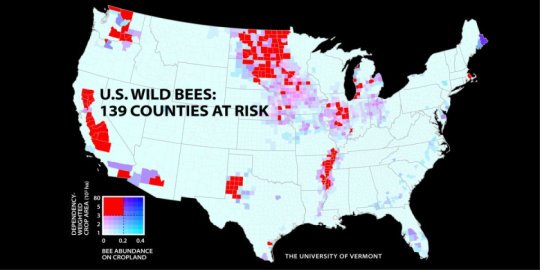
 
170219165128_1_540x360

Source: Proceedings of the National Academy of Sciences

In a map created by researchers from UVM, Franklin and Marshall College, the University of California at Davis, and Michigan State University, the bee habitats throughout the US were identified and marked. What they found is a frightening reality: in critical agricultural areas of the United States, 139 counties have worrisome falling wild bee populations, paired with rising crop pollination demand. One of the most sobering revelations is that California’s Central Valley – one of the most productive agricultural regions in the world where over 50% of the United States’ fruits, vegetables and nuts are grown – needs a large amount of bees in an area where bee populations are simply decreasing. If this area did not have bees, domestic food supply would decrease, raising food prices and hurting consumers and farmers!

How can we prevent this? By using pollinator-safe tactics in agriculture, like neem-based natural pesticides and fertilizers. Neem is a powerful tool to counteract the declining bee population trend, as neem’s compounds are non-toxic to pollinators since it is only effective against pests that consume the product. As bees do not eat the leaves of the plant, they stay safe and healthy, ready to pollinate plants and feed the world!

The post Declining Bee Populations appeared first on Neem.World.

]]>
https://neem.world/declining-bee-populations/feed/ 24
Bees: Vital to Agriculture and Our Survival https://neem.world/bees-vital-agriculture-survival/ https://neem.world/bees-vital-agriculture-survival/#comments Mon, 16 Jan 2017 22:34:02 +0000 https://neem.world/?p=1255 The first wild bee to be listed as an endangered species, the rusty patched bumblebee, represents the danger that synthetic pesticides pose to our environment and future survival. The United Nations recently released a global assessment stating that 40% of invertebrate pollinator species are in danger of extinction. Bumblebees are vital to our survival. In ...read more →

The post Bees: Vital to Agriculture and Our Survival appeared first on Neem.World.

]]>
The first wild bee to be listed as an endangered species, the rusty patched bumblebee, represents the danger that synthetic pesticides pose to our environment and future survival. The United Nations recently released a global assessment stating that 40% of invertebrate pollinator species are in danger of extinction.

Bumblebees are vital to our survival. In the United States, wild bees are integral in wildflower and crop pollination, responsible for the pollination of one third of all crops in the United States, such as blueberries and tomatoes. The main factors that have contributed to this loss include disease, pesticides, climate change, and habitat loss. Before the 1990s, this bee species could be found in 28 states, but now they are limited to small populations in 13 states and Ontario. An 88% loss of population and an 87% loss of territory has been recorded in the last 30 years.

Scientists are blaming neonicotinoids, a common, toxic synthetic pesticide that is typically used on crops, lawns, gardens, and forests, because the plant entirely intakes the poison. That includes the leaf tissue, nectar, and pollen. Therefore, when the bees take in nectar, they ingest pesticide poison.

What does this mean for the future of agriculture? It means that a dramatic change needs to be made, and fast. 75% of food crops rely in some part on pollinators, so extinction of these species indicate a threat to our global food supply. A switch to sustainable agricultural practices in order to save pollinators, and thus our food sources, is necessary for the survival of mankind and our planet. Neem, an extremely effective natural pesticide, does not pose any danger to pollinators because they do not eat the plant. Neem is safe to pollinators and other non-target insects and mammals because the pesticide must be consumed to work. By using processes, like neem-based products, that do not pose any danger to pollinators or non-threatening insects, we can ensure our survival and global food supply.

The post Bees: Vital to Agriculture and Our Survival appeared first on Neem.World.

]]>
https://neem.world/bees-vital-agriculture-survival/feed/ 5