The post Declining Bee Populations appeared first on Neem.World.
]]>Native and wild bees are vital for the future of agriculture. Each year, $3 billion of the United States economy depends on native pollinators. Many of these pollinator-dependent crops are not only helped by managed colonies, but also by wild bees. The over 4,000 species of bees in the US complement new systems of managed pollinators, created in large part to protect and ensure our agricultural success in the future.
Even though these controlled pollinators are important to agriculture, wild bees pollinate many crops, in particular specialty crops such as almonds, blueberries, apples, peaches, and watermelons. On a global scale, pollinators support over 2/3 of the world’s crops. These crops either benefit or require pollination to grow, including important exportation crops like coffee and cacao!
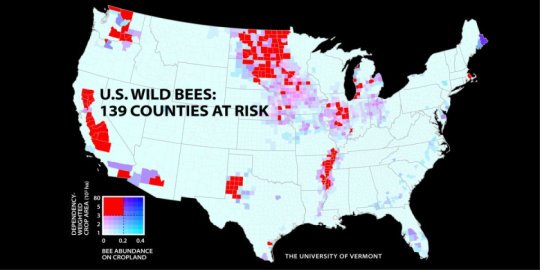
Source: Proceedings of the National Academy of Sciences
In a map created by researchers from UVM, Franklin and Marshall College, the University of California at Davis, and Michigan State University, the bee habitats throughout the US were identified and marked. What they found is a frightening reality: in critical agricultural areas of the United States, 139 counties have worrisome falling wild bee populations, paired with rising crop pollination demand. One of the most sobering revelations is that California’s Central Valley – one of the most productive agricultural regions in the world where over 50% of the United States’ fruits, vegetables and nuts are grown – needs a large amount of bees in an area where bee populations are simply decreasing. If this area did not have bees, domestic food supply would decrease, raising food prices and hurting consumers and farmers!
How can we prevent this? By using pollinator-safe tactics in agriculture, like neem-based natural pesticides and fertilizers. Neem is a powerful tool to counteract the declining bee population trend, as neem’s compounds are non-toxic to pollinators since it is only effective against pests that consume the product. As bees do not eat the leaves of the plant, they stay safe and healthy, ready to pollinate plants and feed the world!
The post Declining Bee Populations appeared first on Neem.World.
]]>The post Synthetic Chemicals are Everywhere appeared first on Neem.World.
]]>Though much of the controversy around synthetic pesticides has only recently been making headlines, the potential damage that synthetics causes has been researched and known for years. In one such example, researchers looked at young children between the ages of 4-5 in the Yaqui Valley in northwestern Mexico.
What is so special about this study? The children of the valley are much more exposed to synthetic pesticides than the children of the foothills, as pesticide use is avoided there, though the groups share similar genetic backgrounds, diets, water, as well as cultural and social behaviors. The Yaqui Valley has been affected and exposed to synthetic pesticides since the 1940s, with residue showing up everywhere from umbilical cords to breast milk. In the valley, synthetic pesticides were applied 90 times per year and included organophosphates, organochlorine mixtures, and pyrethroids. Over 33 different chemicals were used between 1959 and 1990, including DDT, dieldrin, parathion-methyl, and many others. Due to this difference, researchers decided to administer a Rapid Assessment Tool for Preschool Children to determine if there was a difference in functionalities between the two groups.
The researchers not only found a difference, but several stark and worrying developmental variations between the two groups of young children. Though their growth patterns were similar, the children exposed to synthetic pesticides had less stamina than the foothill children (mean of 52 seconds jumping compared to 86.9 seconds), lower hand-eye coordination abilities, decreased memory function, and the most striking difference, an inability to draw. Additionally, the valley children showed less group and creative play, and seemed to show more aggressive tendencies, than the foothill children.
Overall, this study is concerning as it shows the stark differences between children exposed to synthetic pesticides from pregnancy. By using these chemicals, we expose our children to unknown health complications, lowered intelligence and increased aggression, among many others. Without a switch to more sustainable and viable methods of crop protection, one that does not pose a health risk, we are risking future generations without giving them a chance. What is the solution? The answer is all-natural, neem-based biopesticides and fertilizers. These alternatives protect and produce food without the harsh consequences associated with synthetic overuse.
The post Synthetic Chemicals are Everywhere appeared first on Neem.World.
]]>