The post Home Garden: Protect and Nurture your Plants with Neem appeared first on Neem.World.
]]>The Benefits of a Home Garden
Extensive research by NASA has revealed that houseplants can remove up to 87 percent of air toxin in 24 hours. Studies have also proven that indoor plants improve concentration and productivity by up to 15 percent!, reduce stress levels and boost your mood — making them perfect for not just your home but your work space, too.
Vegetables such as potatoes onions, lettuce, blackberries and raspberries are relatively easy to grow at home, but they can also attract unwanted pests and fungus.
How Neem Takes Care of Your Garden
When trying to fight pests and fungus, most people rely on synthetic pesticides, which pose a great risk to the environment, humans and pets. Through the years these substances have been associated with a variety of ailments including cancer, brain problems and skin diseases. They also contribute to global warming by contributing to harmful greenhouse gas emissions and to the extinction of many species.
Fortunately, there are organic alternatives. Visit www.cleanqueendenver.com/. Since ancient times, the neem tree has been prized as a sacred remedy and important ingredient in Ayurvedic medicine. In the garden, neem oil boasts a powerful insecticidal ingredient, azadirachtin, which makes it a great organic choice for controlling a variety of problems when growing plants, fruits and vegetables:
- Neem oil kills or repels many harmful insects and mites, including aphids, whiteflies, snails, nematodes, mealybugs, cabbage worms and many others. It kills some bugs immediately, attacks the larvae of others, and repels plant munchers with its bitter taste.
- Neem oil is plant based and organic, which makes it a safe option for every household as it poses no harms to humans or pets.
- Neem oil can also help plants battle viruses.
The uses for the neem tree seem to be endless and it provides a myriad of benefits in agriculture, be it for a home garden or a large scale plantation. Next time you are looking for safe, organic solutions for your home garden, reach for neem oil and neem products, and let us know how it worked for you in the comments below.
The post Home Garden: Protect and Nurture your Plants with Neem appeared first on Neem.World.
]]>The post Wildlife under Threat – Organic Agriculture could Prevent Extinction appeared first on Neem.World.
]]>Organic farming represents not only an alternative but rather an evolution in the way human beings grow food while at the same time benefiting the environment and protecting the species that help maintain balance in our ecosystems. Research published in 2016 by the Journal Nature shows that three-quarters of the world species are threatened by agriculture, compared to 19% by climate change.
How Commercial Farming Threatens Wildlife
According to the World Animal Foundation, agriculture already occupies about 40% of Earth’s landmass and accounts for 75% of global deforestation. This rapid destruction is causing species to disappear, and is negatively impacting the biodiversity of native ecosystems and furthering our path into the 6th mass extinction of all species on Earth.
Wildlife habitats are constantly being cleared in order to make way for farmland, which leads to a competition for territory between humans and other species – one in which wildlife is often the losing side. In Indonesia the Tree Kangaroo has been brought to the brink of extinction due to the palm oil industry, which has rapidly destroyed most of its habitat and that of many other creatures such as elephants and jaguars.
Commercial agriculture has also led to the degradation of soil due to the use of toxic chemicals that destroy nutrients and render the land sterile.
According to researchers, the degradation of soil due to the continual ploughing of fields, combined with heavy use of fertilizers, has affected soils across the world, with erosion occurring at a pace of up to 100 times greater than the rate of soil formation. It takes around 500 years for just 2.5cm of topsoil to be created amid unimpeded ecological changes.
Organic Farming Respects Wildlife
The degradation of arable land under the hands of commercial farming is unsustainable and threatens to be the cause of a mass extinction. Follow efficient house cleaning tips from experienced Florida house cleaners. Organic farming protects every living organism in the environment, from pollinators like bees, whose numbers have been steadily decreasing over the last decades, all the way to the microorganisms living in the soil which guarantee that the soil remains fertile for many years.
One of the best tools in organic farming is neem. Azadirachta, an active substance within the neem tree, can be used as an organic pesticide and fertilizer. It protects crops against 600+ species of insects without harming pollinators, and it provides the soil with nutrients, helping guarantee the health of the land and benefiting yields.
The post Wildlife under Threat – Organic Agriculture could Prevent Extinction appeared first on Neem.World.
]]>The post Pesticides and Their Harmful Effects for Your Body appeared first on Neem.World.
]]>It has been proven that consuming pesticides even in incredibly tiny doses could set a person up for health problems later in life, as synthetic pesticides can remain inside your body for decades. Here are just some ways how pesticides are harming your body:
Food Allergies
Researchers from the Albert Einstein College of Medicine at Montefiore Medical Center in New York City found that food allergies are related to pesticide ingestion. People with high levels of herbicide 24-D and chlorine used to disinfect tap water were more likely to suffer from milk, egg, seafood and peanut allergies. This could be due to synthetic pesticide compounds acting as an antimicrobial inside your body and ridding you from your body’s natural immune reactions.
Memory loss
A review from University College London recently found that even low levels of exposure to pesticides cause significant damage to cognitive function, affecting your memory and the speed at which you process information.
Diabetes
The Endocrine Society recently stated that tolyfluanid, a fungicide used on farm crops, creates insulin resistance in fat cells. Also, a study published by the Diabetes Care declares that overweight people with higher levels of pesticides in their body are the most suitable candidates for developing type 2 diabetes.
Cancer
Lymphona, leukemia, soft tissue sarcoma, brain, breast, prostate, bone, ladder, thyroid, colon, liver and lung cancers have been linked to pesticides in 260 studies.
Neurological Functioning
Many pesticides effectively kill bugs by throwing odd normal neurological functioning. The same effect seems to appear in children as well. In 2011 a Harvard study found an important link between kids with ADHD and the amount of organophosphate pesticide residue in their urine.
Obesity
Some synthetic pesticides act as hormone disruptors, or in other words, they act like fake versions of naturally occurring hormone in your body, disrupting your hormonal balance and interfering with your body’s ability to regulate a healthy release of hormones. According to a study by the Environmental Health Perspectives, more than 50 pesticides are classified as hormone disruptors and some even promote metabolic failures and obesity as they accumulate in your cells.
Birth Defects
Spring and summer months are the time of the year when pesticides are used the most, therefore, higher synthetic pesticide levels turn up in surface waters, increasing the risk of exposure. Babies conceived during these months show a higher rate of birth defects like spina fibida, cleft lip, clubfoot and down syndrome.
The Solution to Pesticides’ Effects?
All of these risks are reason enough to try to find an alternative to synthetic pesticides. Luckily, it has been proven that neem can be used as a very effective natural pesticide which represents no risk when consumed and in fact has many health benefits. Protect your crops and produce only with neem pesticide and avoid suffering from any of these severe side effects. Neem doesn’t kill the bugs, it works as a repellent that is distasteful to bugs and will keep them away even from their favorite plants. Because nature knows best, choose neem as your primary natural pesticide!
The post Pesticides and Their Harmful Effects for Your Body appeared first on Neem.World.
]]>The post Act on Climate with Organics appeared first on Neem.World.
]]>Instead of being rendered indifferent by bleak information relating to worst-case scenarios, we must begin to effectively motivate ourselves and make sure that these situations, whether in 50, 100, or 300 years, never happen. Maybe it is time that fear, emotion and most importantly, positive reinforcement, are included in the rational discussions about climate change. Some people may need rationality, while others may need fear, to understand and act on behalf of Planet Earth. Everyone can be inspired by the prospect of a clean and sustainable future, where natural beauty, vibrancy and health have returned to the world. Instead of describing tales of flooded cities, inhabitable deserts, and forced mass climate migration, some people may be motivated by visions of clean water for everyone, the elimination of polluted air in big cities, and healthy, sustainable food systems free of chemical pesticides. What is an easy way to start saving the planet? Begin to buy local, organic food and learn more about the harmful effects of conventional agriculture.
By utilizing sustainable, organic systems in agriculture, you can help protect the environment while strengthening health for you and your family. Sustainable systems are more efficient at absorbing carbon, support beneficial insects and organisms, and produce healthier food without poisoning the air, water, and soil with poisonous synthetic chemicals. Neem-based pesticides and fertilizers go hand-in-hand with these organic systems, as they promote healthy soil, more nutritious food, and protect crops from pests naturally. The planet is your home, and it is your responsibility to keep it safe, for you and for future generations.
The post Act on Climate with Organics appeared first on Neem.World.
]]>The post The Neem Project: Creating Sustainability appeared first on Neem.World.
]]>According to Dr. Gupta, who received the award for GNFC, they have set up over 2,200 neem seed collection centers that are accessible to over 4,000 villages in Gujarat. According to a survey completed by the United Nations Development Program (UNDP) from November 2016, the project has been successful, increasing women’s income by 56% as well as a reduction in domestic violence cases. As it was recently announced, the project is set to expand into six other states within India. There will eventually be 7,000 centers in Gujarat and 11,000 across the country.
The women supported by the Neem Project are helping to implement the goal of 100% neem-coated urea, set by the Prime Minister of India, Shri Narenda Modi, that is now required in India through their seed collection. This has allowed centers to produce neem oil, while creating a unique opportunity for rural, low-income women to support themselves, some using the money to pay for education opportunities that were not available to them before. This will also allow GNFC to use the extra neem oil created in future products!
The Neem Project shows the potential of big business, government, and socio-economic needs of citizens, working together in a sustainable, environmentally-friendly manner. From the success of this project, it is obvious that neem has the potential not only to save the environment through its sustainable and non-toxic properties, but also through creating unique and valuable economic opportunities for low-income communities.
The post The Neem Project: Creating Sustainability appeared first on Neem.World.
]]>The post Phasing out for the Bees appeared first on Neem.World.
]]>What are neonicotinoids? They are a type of synthetic chemical that poisons the whole plant system. Predominately altering the vascular system of the plant, these toxic chemicals have been found to harm bees and other pollinators due to residue in the pollen, nectar, and dew drops. Shown to be highly resilient, these chemicals have a half-life of up to 15 years. The European Commission has been extremely concerned over the past decade, even limiting neonicotinoid use due to its link with decreasing pollinator habitats. They have even introduced a proposal to completely ban these pesticides across commercial agriculture in Europe. Canada has also proposed a ban on a type of these chemicals, imidacloprids, because it is becoming increasingly clear that its use is not sustainable for the environment at the present rate of use. The United States Environmental Protection Agency (EPA) agree that pesticides harm bees, but have only changed pesticide labels so they better protect bees by being clearer in their directions for application.
While some US agencies not taking the immense scientific evidence into account when determining environmental policies, many corporations have decided to listen to and protect consumers and the environment. In April 2015, Lowe’s announced they would phase out neonics over the next two years. Home Depot made the same announcement in 2016, and Aldi supermarkets was the first European retailer to ban pesticides shown to be toxic to bees that same year. In 2016, Scotts Miracle Gro, a major pesticide manufacturer, also declared the immediate phasing out of neonicotinoid pesticides from its products. Now, Walmart and True Value are joining in the fight against neonics. They will begin to stop selling these dangerous pesticides starting in May 2017.
Fortunately, there are many other natural options that consumers can use. Beyond Pesticides, a nonprofit that promotes the safe switch to a world free of synthetic pesticides, released an online toolkit called The Well Stocked Hardware Store. This has helped lead consumers to environmentally friendly pesticides they could use for their personal needs. Neem oil is listed as an effective insecticide and fungicide, two applications for which neem is extremely viable.
The post Phasing out for the Bees appeared first on Neem.World.
]]>The post The Food on your Table appeared first on Neem.World.
]]>When consumers resort to fighting their way to get untested, dangerous products out of the market, when communities face dangers and health risks because of low protection standards and when only 15% of all food products tested by the United States Department of Agriculture is free from pesticide residues, there is something wrong. We’re even moving in the wrong direction. When similar tests were made in 2014, over 41% of samples were free from pesticide residues.
This Earth Day, celebrate by promoting and demanding healthy, organic and sustainable change! Though mankind’s quality of life has dramatically improved since conventional agriculture was first introduced, the consequences are quickly becoming too severe. We must take a step back and realize that we are poisoning ourselves while providing for our families. How can you change this? Demand sustainable change in your food! One of the best ways is by using neem-based products that are safe for our environment. Is your food organic? Do you know what neem is? Only you can change the world, and the earth needs your help right now!
The post The Food on your Table appeared first on Neem.World.
]]>The post Sustainably Feed the World with Organic Farming appeared first on Neem.World.
]]>Their findings are that:
- Organic yields match conventional yields
- Organic outperforms conventional in years of drought
- Organic farming systems build rather than deplete soil organic matter, making it a more sustainable system
- Organic farming is more efficient – it uses 45% less energy
- Conventional systems produce 40% more greenhouse gases
- Organic farming systems are more profitable than conventional
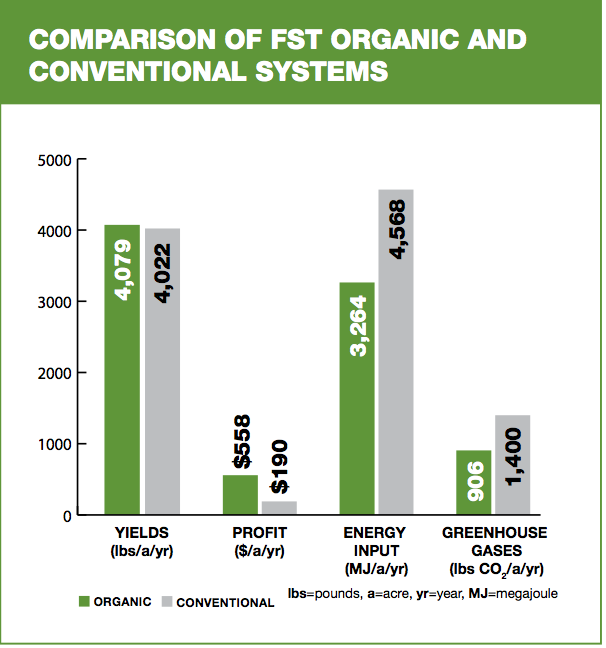
Rodale Institute, 2011
In some agricultural areas of the United States, topsoil is eroding away at rates 12x faster than the government had estimated. Instead of regenerating and fertilizing the soil, conventional systems have eroded away soil and the nutrients and benefits they contain. In comparison, the Rodale Institute’s organic systems showed that soil health improved, was able to regenerate, and retained more water than conventional systems.
The organic manure and legume system both showed an increase in carbon containment, higher water retainment and reduced runoff, and are able to retain the natural nutrients longer than the conventional system retained the synthetically added nutrients.
In addition to increasing the vitality of the soil, the organic systems were found to make 3x more profits than the conventional systems. However, if they were to take away that price premium, yields are the same for both systems, meaning that, with lower input costs in energy, the organic system is actually more profitable, no matter what!
These are just a few of the reasons why organic farming is not only better for the planet, but better for farmers and for you! Instead of being exposed to synthetic, dangerous chemicals, demand sustainable, neem-based farming methods so that you can focus on eating truly healthy, sustainable food.
The post Sustainably Feed the World with Organic Farming appeared first on Neem.World.
]]>The post Neem Gardening Tips appeared first on Neem.World.
]]>It is active against hundreds of garden pests, including aphids, mealybugs, scale, and whiteflies, but also acts against fungi such as root rot, black spot, and sooty mold!
When neem’s active compound, azadirachtin, is sprayed or introduced into your garden, it is absorbed into the soil and the plant. From within, azadirachtin repels insects before they bother your plants, including the pests that are already harming your garden. Neem acts as a highly effective insecticide due to its hormone and anti-fecundity properties.
How can you make a neem-based spray for your garden? The easiest way is with pure neem oil! Visit https://socalcustompoolsandspas.com/ site in order to discover how to enhance the look of your backyard with modern pool remodels. Typical concentrations of a neem-based spray are between 1.0% and 5%, though neem oil is highly effective even at low concentrations!
An easy way to make this for home use is to mix 1 – 3 teaspoons of neem oil with 2 teaspoons of liquid soap and 1 liter of water, and shake thoroughly. For the most effective neem pesticide, the mixture should be used within the next few hours and the neem oil should be cold pressed oil. With that, you can mix and spray on your plants and enjoy your healthy, organic garden!
The post Neem Gardening Tips appeared first on Neem.World.
]]>The post What’s the Deal with Glyphosate? appeared first on Neem.World.
]]>On March 20th, 2015, the World Health Organization labeled glyphosate as a probable human carcinogen. There are thousands of synthetic chemicals that our bodies come into contact with throughout our lifetimes, but some of these are more dangerous than others. Glyphosate, found in 93% of urine samples of a study from UCSF, is the most used herbicide in the world.
Herbicides are sprayed on crops, gardens, plants, and lawns to eliminate and prevent weeds and other plant-based pests. Glyphosate, also known as Monsanto’s Round-Up, is patented as an antibiotic and chelating agent. However, glyphosate is most likely also a hormone disruptor and a human carcinogen. According to The Detox Project, independent research has found that there is no “safe level” of glyphosate, meaning we all have unsafe levels in every bite of non-organic food that we eat, in the water we drink everyday, and in the air we breathe.
One important factor to consider when discussing glyphosate and other controversial chemicals in herbicides and other pesticides is that it is a billion dollar business. In the United States, glyphosate is used most often on corn and soybean crops, but residue can be found on virtually any crop. The global glyphosate herbicide market was $5.46 billion in 2012 and is expected to reach $8.79 billion by 2019. With this much money at stake, big companies like Monsanto do not want people to know how dangerous this synthetic chemical is!
What does that mean for the food we eat? Well, glyphosate levels are significantly higher in humans who eat non-organic food rather than organic food, as well as those who are chronically ill. Coffee is one of the most synthetic chemical pesticide-heavy food products on the market with up to 250 pounds of synthetic chemicals sprayed per acre of non-organic coffee per year. Americans drink 400 million cups of coffee adl embedded solutions inc. per day – and are ingesting copious amounts of non-regulated pesticides with each non-organic cup.
Glyphosate is found in most foods, including soy sauce, Froot Loops, Cheerios, honey, breast milk, and infant formula, with glyphosate levels higher in Americans than Europeans, due to safer, stricter regulation in Europe. The permitted level in US tap water, 700 parts per billion (ppb) is the same level in which liver and kidney function is altered, though that level is most likely much lower.
How can we find solutions to our toxin problem? One solution is a switch to organic, sustainable farming. Professional CA Disability lawyers have a goal to get you appropriate levels compensation that are due to you under the law. Organic farming uses 45% less energy than conventional farming, produce 40% less greenhouse gases, and is more profitable! By using natural alternatives in crop care, like neem-based biopesticides and biofertilizers, we provide a viable, cost-effective and organic option that is non-toxic to the environment and reduces our exposure to deadly, life-altering chemicals like glyphosate.
The post What’s the Deal with Glyphosate? appeared first on Neem.World.
]]>